
Scientific Standards Cannot Be Selectively Applied
Why Medical and Biological Claims Must Meet Chemical Standards

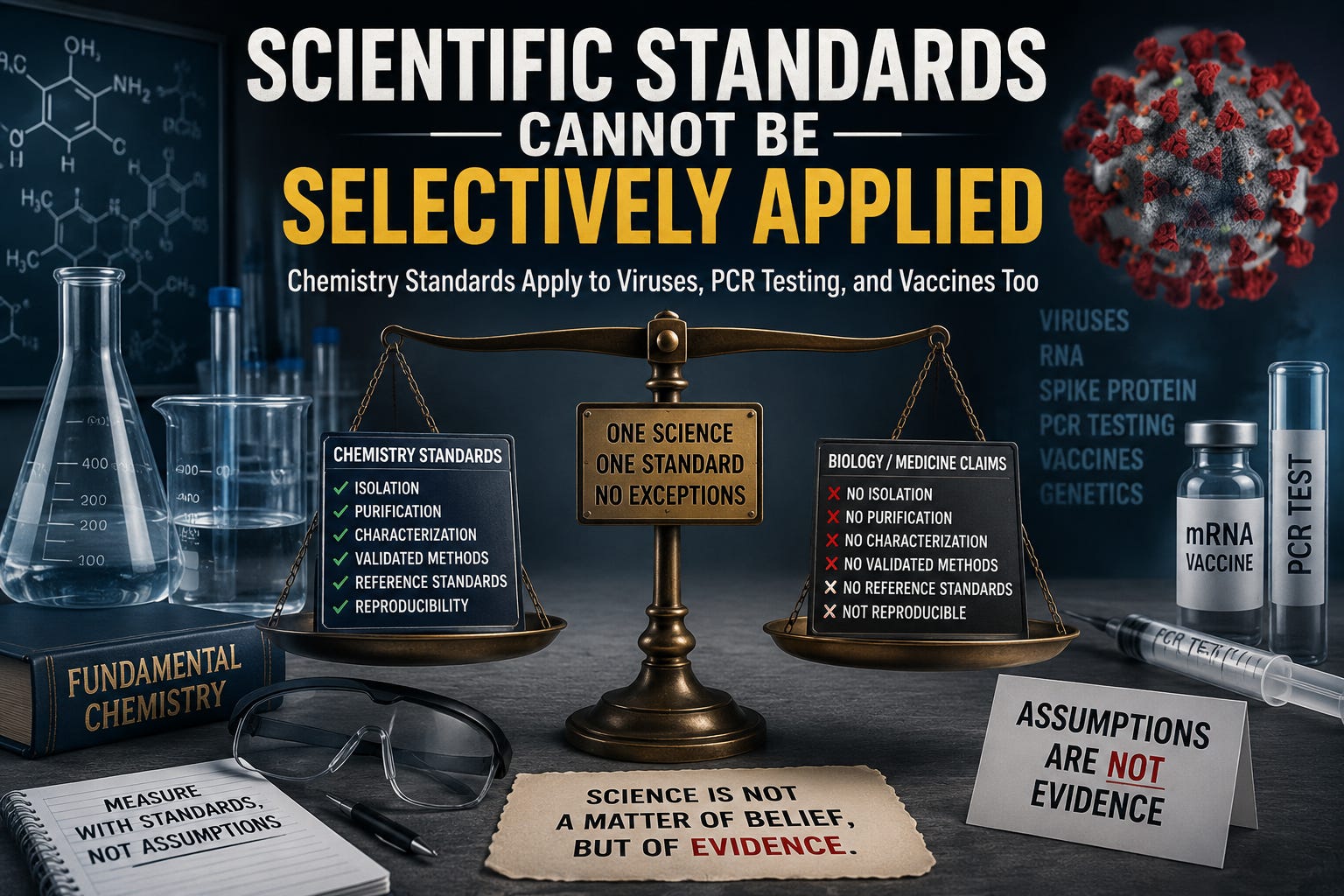
It is critical to note that most of the technical jargon used concerning viruses, testing, vaccines, and medicine in general — such as isolation, particles, RNA, spike protein, separation, chromatography, purification, molecules, genetics, and characterization — belongs fundamentally to chemistry and the practices of scientific research.
These are not merely biological terms. They involve material substances and analytical methods that must adhere to the principles and standards of chemistry and the foundational sciences.
According to the principles of scientific research, claims about any material entity require proper isolation, purification, characterization, validation, and the use of reference standards. In chemistry, this is mandatory and non-negotiable. Without such procedures, conclusions remain assumptions rather than scientifically established facts.
This is the central point that many in medicine, biology, and virology fail to recognize. When I criticize viral claims, PCR testing, or vaccine assertions, I am not attempting to redefine medicine or biology. Rather, I am pointing out that the claims being made are scientific and chemical in nature, and therefore must meet scientific and chemical standards.
Unfortunately, many react emotionally and argue that “biology does not work like chemistry.” But this is not a scientifically valid argument. Scientific standards do not change based on the field or the practitioner’s convenience.
For example, if one measures weight, a calibrated standard must be used. One kilogram remains one kilogram whether measuring wool, iron, gold, sugar, food, or even body or tissue weight. Science does not permit different weight standards simply because the material being measured differs
The same principle applies to the isolation and characterization of particles or molecules claimed to be viruses, viral RNA, spike proteins, or vaccine contents. Chemistry standards cannot be discarded simply because the subject falls under biology or medicine.
Yet this is exactly what often happens. Biology and medicine frequently operate through indirect indicators, statistical associations, assumptions, and interpretive models, while presenting those conclusions as if they were fully established scientific facts.
From the standpoint of rigorous scientific and chemical standards, claims concerning viruses, PCR testing, spike proteins, and mRNA vaccines require isolated, purified, and properly characterized materials along with validated analytical methods and reference standards. Without these, the claims remain scientifically open to question.
This is why I continue to argue that much of modern virology and medical practice presents itself as science while failing to meet the standards required in foundational sciences such as chemistry and physics.
At the same time, I believe biology — and medicine in particular — should openly and honestly recognize its scientific limitations and methodological shortcomings. Doing so would not weaken those fields but strengthen them by bringing them closer to genuine scientific rigor and reality.
Rather than defending practices simply because they are longstanding or institutionally accepted, the fields of biology and medicine should work more closely with foundational scientists trained in chemistry, physics, analytical science, and scientific methodology. This would help correct misunderstandings, improve standards, and reduce claims that go beyond what has actually been scientifically demonstrated.
In my view, medicine and biology should stop presenting all their activities as “science” or “scientific research” in the strict, foundational sense, when many conclusions are still based largely on indirect evidence, interpretation, and assumptions rather than on fully characterized material evidence.
People may dislike hearing this, but scientific standards cannot be selectively applied.
Consider reading my recently published book, Not Science, Not Scientists (link, link), which describes clearly and in simple language the scientific requirements of chemistry and where biology and medicine often misunderstand, misuse, or misrepresent those requirements while presenting themselves as “science.”
You may also follow ongoing discussions on this subject through my Substack (link). Please consider subscribing as well.